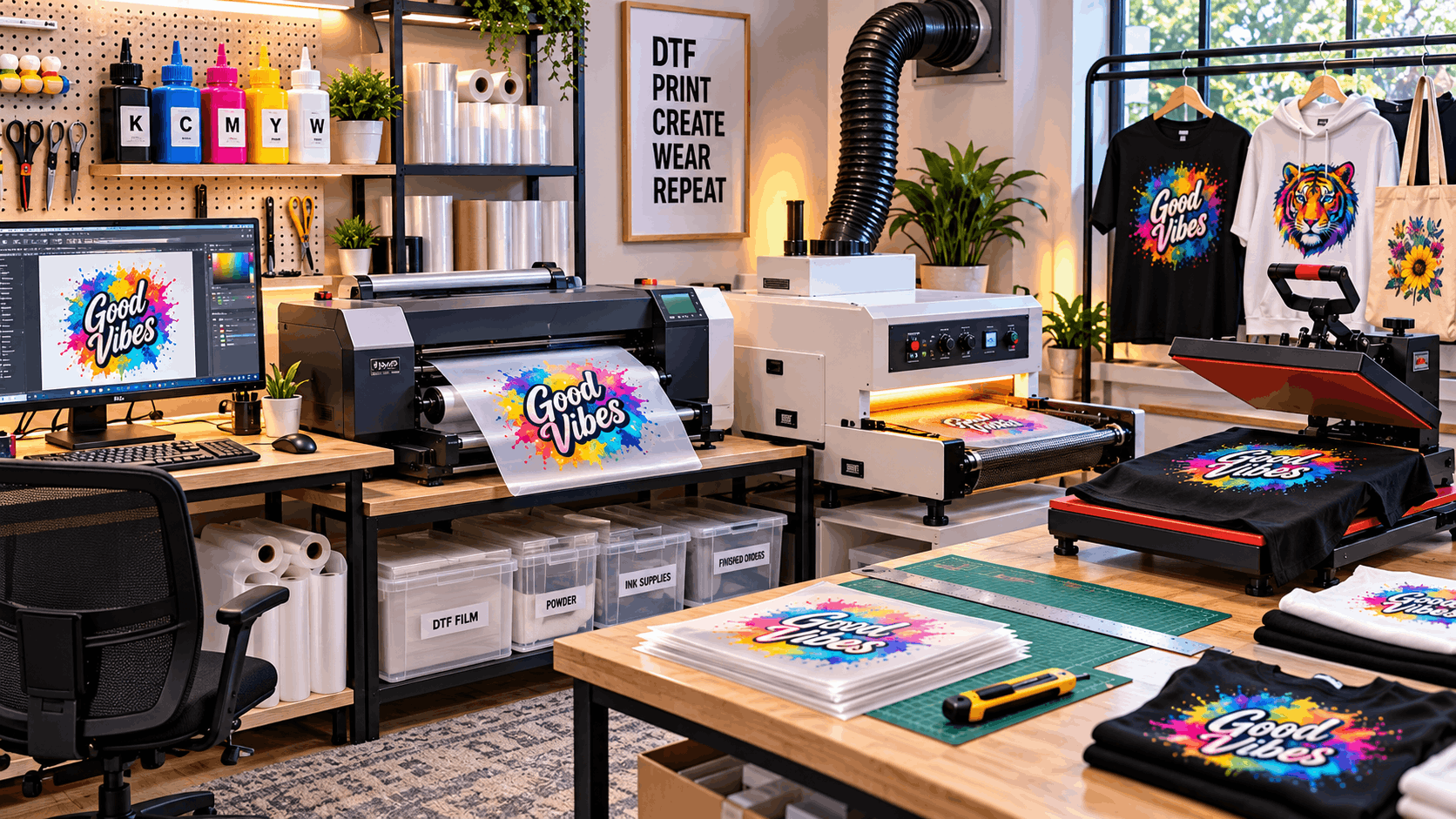
A small DTF printing setup does not necessarily require a large commercial workshop. A compact home studio or small print room can work when there is enough space for the printer, curing process, heat press, consumables, garment handling, ventilation, and routine maintenance. The key is to plan the complete workflow rather than measuring space for the printer alone.
An efficient layout should also allow you to move printed film and garments between production stages without creating clutter.
What Equipment Needs Space in a DTF Workspace?
The printer is only one part of a DTF production area.
A basic workflow can involve:
- a DTF printer;
- computer or laptop;
- PET transfer film;
- DTF inks;
- adhesive powder;
- curing equipment;
- heat press;
- maintenance supplies;
- blank garments;
- finished transfers and orders.
Each item needs a suitable location.
Some equipment can fit on a workbench. Other components need their own stable surface and enough surrounding room for safe, practical operation.
Before setting up the room, list every piece of equipment you intend to use.
Start With the Printer Area
Your printer should have a stable and accessible position.
Do not plan only around the machine’s external dimensions. You may also need space to load PET film, access ink components, perform nozzle checks, and carry out cleaning.
Roll-fed systems may require clear space around the film path as well.
For a home studio where available room is limited, a compact DTF printer can reduce the footprint required for the printing stage. However, the surrounding curing and pressing equipment must still be included in the overall layout.
Avoid placing the printer in a location where routine maintenance becomes difficult.
Easy access can make daily operation more practical.
How Much Room Does a Heat Press Need?
A heat press often requires more working space than its closed dimensions suggest.
The press needs to open fully. You also need room to position garments, align transfers, remove finished items, and work without constantly moving nearby equipment.
Some heat-press designs open upward. Others swing to the side.
A swing-away design can require additional clearance beside the machine. Therefore, consider how the press moves before choosing its location.
Keep the pressing area organised so blank garments and finished products do not interfere with hot equipment.
Plan a Separate Curing Area
DTF transfers need curing after adhesive powder has been applied.
Depending on the workflow, this may involve dedicated curing equipment or another suitable system designed for the process.
The curing stage should have its own practical working area.
Printed film must move from the printer through powdering and curing without being damaged or contaminated. Crowding these stages together can make handling more difficult.
A logical arrangement reduces unnecessary movement.
For example:
Printer → powdering area → curing station → heat press → finishing area
This creates a clear direction for production.
Ventilation Should Be Part of the Layout
Ventilation should be considered when planning a DTF workspace.
Printing, powder handling, curing, and heat-related processes should be carried out according to the safety guidance supplied with the equipment and consumables.
Do not treat ventilation as an afterthought once every machine has already been positioned.
Instead, consider airflow and any equipment-specific ventilation requirements during the initial layout.
A small room can still be organised effectively, but limited space makes sensible equipment positioning even more important.
Storage Is Easy to Underestimate
Consumables can quickly occupy valuable working space.
A DTF operation may need storage for PET film, inks, adhesive powder, cleaning supplies, blank clothing, packaging materials, and completed customer orders.
Leaving everything on the main production table creates clutter.
Instead, use dedicated storage where appropriate.
Shelving, drawers, cabinets, and labelled containers can help separate production materials from finished products.
Store inks, films, powders, and other consumables according to their supplier instructions. Keep them away from unsuitable heat, moisture, or other environmental conditions.
Create a Dedicated Film-Handling Area
PET film needs careful handling during the workflow.
A clean work surface can help when inspecting printed film, applying or managing powder, and preparing transfers for curing.
Avoid using the same small surface for unrelated tasks if this increases the chance of contamination.
Dust, fibres, loose powder, and other debris can interfere with an organised production environment.
Even a modest table can work if it has a clearly defined purpose.
Can You Run DTF Printing From a Home Workspace?
A home-based setup may be practical if the space can safely accommodate the required equipment and production activities.
A spare room, dedicated studio, or workshop may provide enough room for a compact system.
However, simply finding an empty desk is not enough.
Ask whether the space provides:
- stable equipment surfaces;
- suitable electrical access;
- enough room for the heat press;
- practical ventilation;
- organised consumable storage;
- safe film and powder handling;
- maintenance access;
- room for blank and finished garments.
The workspace should support the complete process without requiring constant rearrangement.
Keep Clean and Production Areas Organised
A small print shop benefits from clear work zones.
One area can handle digital artwork and order management. Another can be reserved for printing and transfer preparation. A separate surface can handle garment finishing and packaging.
These zones do not need to be in separate rooms.
The purpose is simply to prevent different activities from interfering with each other.
For example, packaging materials should not cover the area where printer maintenance is performed. Likewise, finished customer garments should not sit next to loose adhesive powder.
Organisation becomes increasingly important as order volume grows.
Think About Maintenance Access
DTF printers need routine attention, especially around the ink system and printhead-related components.
Your layout should allow you to reach the areas that require cleaning or inspection.
Placing the printer tightly between walls, shelves, and other equipment may save a small amount of floor space. However, it can make maintenance frustrating.
Before finalising the layout, imagine carrying out normal tasks.
Can you load film comfortably?
Can you inspect the printer?
Can you access maintenance points?
Can you clean the work area without moving heavy equipment?
If not, the arrangement may be too cramped.
Leave Room for Business Growth
A beginner does not need to build a large production facility immediately. Still, some flexibility can make future changes easier.
Your order volume may increase. You might add more garment storage, a larger heat press, additional curing capacity, or another production machine.
A modular layout can help.
For example, movable storage and clearly separated workstations may be easier to reorganise than permanently crowded surfaces.
Growth planning does not mean leaving half the room empty. It simply means avoiding a layout that cannot adapt at all.
How Should You Arrange a Small DTF Printing Setup?
Start by mapping the order in which materials move through production.
The printer should feed naturally into the transfer-preparation area. From there, the film should move toward curing and then to the heat press.
Finished garments can then move to inspection, cooling where required, folding, and packaging.
Try to avoid workflows where operators repeatedly cross the room or carry delicate printed film around obstacles.
A simple production path saves space because each area has a defined purpose.
A Small Workspace Can Still Be Efficient
The amount of space required for DTF printing depends on the equipment, production volume, and products being made. There is no single room size that suits every business.
Instead of focusing on a fixed floor-area number, plan around the complete workflow. Include printing, film handling, powdering, curing, pressing, storage, maintenance, ventilation, and garment finishing.
A well-organised small DTF printing setup can be more practical than a larger but poorly arranged room. The goal is to give every production stage enough space to operate safely and efficiently while keeping materials moving through a clear, manageable workflow.