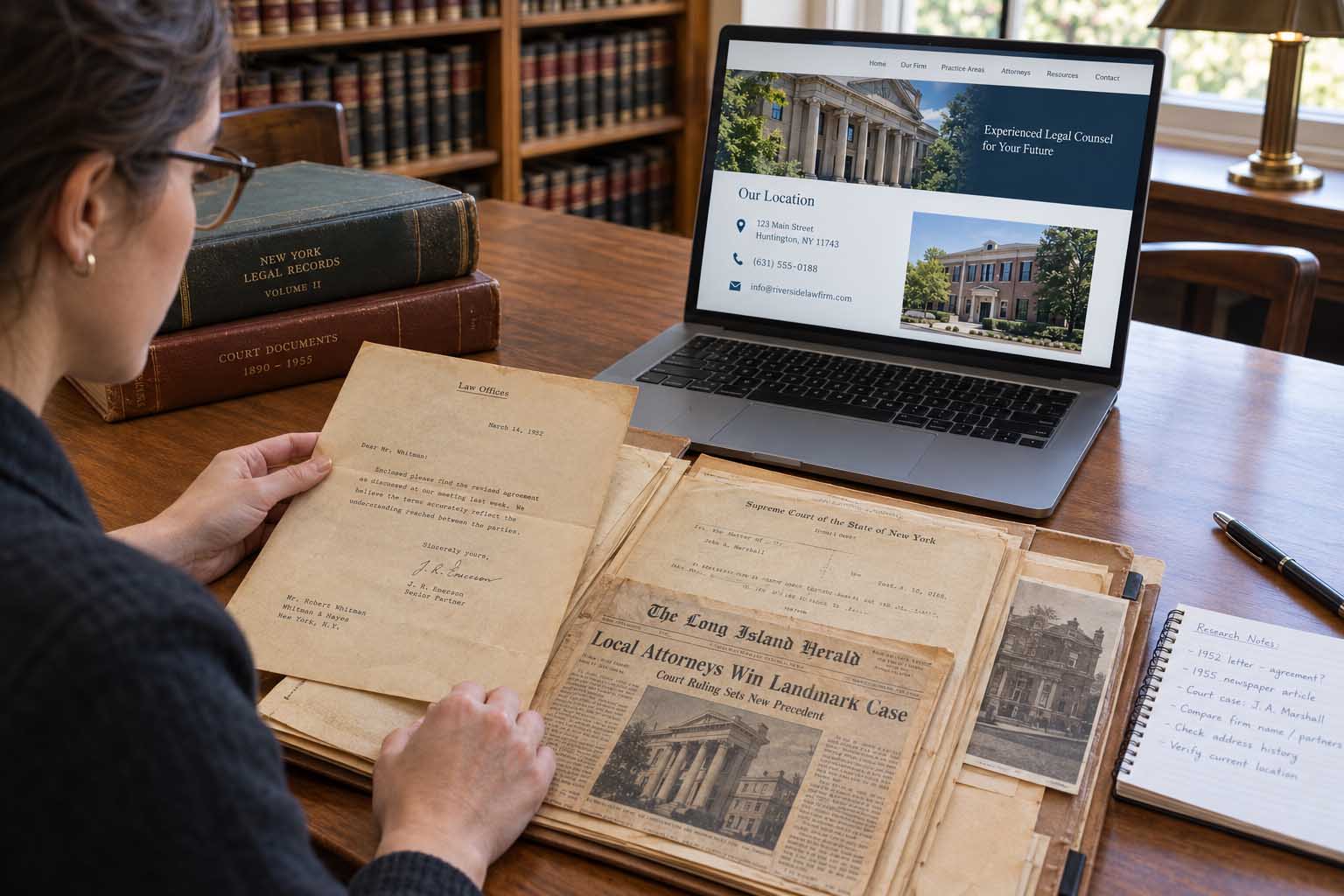
Researching law firm founding history involves examining reliable records that explain when a legal practice began, who established it, and how its professional identity developed. Useful sources include official firm websites, historical newspapers, archived directories, public records, and professional biographies.
A firm’s founding history can provide context about its origins and development. However, historical longevity should not be confused with proof of current legal qualifications or guaranteed results.
For individuals researching attorneys in Suffolk County, Nassau County, or elsewhere in New York, examining a firm’s background can be one part of a broader evaluation.
Why Research a Law Firm’s Founding History?
Historical directories provide valuable evidence for researching law firm founding history, especially when comparing earlier office locations, attorney names, and business records.
A law firm’s history may explain how the organization developed and which communities it has served.
For example, a practice that began decades ago may have experienced changes in ownership, attorney membership, office locations, or practice areas.
Understanding these developments can help researchers distinguish between a firm’s original founding date and its current business structure.
In addition, historical research may clarify whether a firm’s name comes from its founders or later partners.
However, a long operating history does not automatically establish professional competence.
Current attorney credentials and relevant experience require separate verification.
1. Start Your Law Firm History Research With the Official Website
The firm’s official website is often the easiest starting point.
Look for sections labeled About, Our History, Firm Background, or Attorney Profiles.
These pages may identify:
- The firm’s founding year
- Its original founder or founders
- Earlier office locations
- Changes in firm leadership
- Important developments in its practice
However, researchers should treat information published by the firm as a starting point rather than independent historical confirmation.
Record the Exact Founding History Claims
When researching a founding date, write down the specific claim.
For example, distinguish between a statement that a firm began operating in a particular year and a statement that its current attorneys collectively have many years of experience.
These claims describe different things.
Accurate research requires keeping them separate.
2. Research a Law Firm’s Founding History Through Newspapers
Historical newspapers can provide independent evidence of a law firm’s early activities.
Older publications may contain legal advertisements, attorney announcements, office openings, or reports involving the firm’s founders.
For example, a newspaper advertisement from a particular year may establish that an attorney practiced at a specific address at that time.
However, it does not necessarily establish the exact date the firm began operating.
What Historical Newspaper Records Should You Look For?
Useful historical references may include:
- Announcements of new law offices
- Attorney partnership notices
- Business advertisements
- Professional association announcements
- Reports identifying an attorney’s office address
Whenever possible, record the publication name, date, and relevant details.
This makes it easier to compare historical evidence with the firm’s published account.
3. Examine Archived Business and Legal Directories
Older business directories may help researchers trace a firm’s development.
For example, historical telephone books and professional directories sometimes identify attorneys by name, office location, and practice.
Comparing records from different years may reveal changes in the firm’s address or professional structure.
However, directory entries can contain errors or omissions.
Therefore, researchers should compare multiple sources before drawing conclusions.
4. Investigate the Law Firm’s Founders and Early History
Understanding law firm founding history also requires examining the professional backgrounds of the original attorneys and identifying when their legal practice began.
A firm’s founding history often connects closely to the professional background of its original attorneys.
Researchers can examine available biographies, historical publications, and professional records.
For example, a founder’s career timeline may help explain when the practice began and how it developed.
Example of a Long Island Law Firm’s Founding History
One example is Siben & Siben, a law firm based in Bay Shore, New York.
The firm’s history dates to 1934, when Sidney R. Siben established the practice.
Its published background provides an example of how a founding year and founder’s identity can form part of a firm’s historical record.
The firm is located at 90 East Main Street in Bay Shore, Suffolk County, and provides legal services to clients on Long Island.
Researchers examining this history can compare the firm’s published information with available historical publications and professional records.
However, a historical founding date should not be interpreted as a guarantee of any particular legal outcome.
5. Check Public Records for Law Firm Formation Details
Public records may provide additional context about a firm’s organizational history.
Depending on the business structure and available records, researchers may find information concerning entity formation, registered names, or business addresses.
However, a business registration date does not always match the original founding date of a legal practice.
For example, an attorney may establish a practice before forming a later partnership or professional entity.
Therefore, researchers should evaluate these dates separately.
Understanding Founding Dates and Registration Dates
A founding date generally describes when a practice began operating.
By comparison, a registration or entity formation date may reflect a later organizational change.
For instance, an attorney might begin practicing independently before joining another attorney to establish a partnership.
As a result, different records may contain different dates without necessarily contradicting one another.
6. Compare Law Firm History With Current Attorney Qualifications
A law firm’s founding history and an individual attorney’s current professional standing are different subjects.
Historical research may establish that a firm began operating many years ago.
However, that information does not establish whether a particular attorney is currently registered or qualified to handle a specific matter.
In New York, prospective clients can review attorney registration information through the New York State Unified Court System Attorney Search.
This official resource provides publicly available attorney registration details.
In addition, prospective clients should evaluate the attorney’s relevant practice experience.
Questions to Ask When Researching a Law Firm
When researching a firm, consider:
- When did the original practice begin?
- Who founded the firm?
- Has the firm’s name changed?
- Has its office location changed?
- Do independent records support its historical claims?
- Which attorneys currently handle the relevant legal matters?
These questions help separate historical background from present-day professional information.
7. Verify a Law Firm’s Founding History Across Multiple Sources
Reliable historical research involves checking whether different sources support the same account.
For example, an official website may identify a founding year, while an archived newspaper advertisement confirms that the founder practiced during that period.
Together, these records may strengthen the historical account.
However, apparent inconsistencies do not always indicate inaccurate information.
A firm may have changed names, reorganized, or relocated.
Therefore, researchers should consider the broader timeline before assuming that two records conflict.
Common Mistakes When Researching Law Firm History
One mistake is treating a firm’s current business registration date as its original founding date.
Another is assuming that every attorney associated with a longstanding firm has personally practiced for the same number of years.
In addition, researchers sometimes rely entirely on promotional descriptions without checking independent sources.
A more reliable approach involves reviewing historical evidence, confirming dates, and distinguishing organizational history from individual attorney credentials.
Final Thoughts on How to Research a Law Firm’s Founding History
Accurate law firm founding history research combines official information with historical newspapers, archived directories, and independently verifiable records.
These sources can help establish when a practice began, who founded it, and how its identity developed over time.
However, historical longevity represents only one aspect of a law firm’s background.
For prospective clients on Long Island and throughout New York, combining historical research with verification of current attorney qualifications provides a more complete understanding of a legal practice.