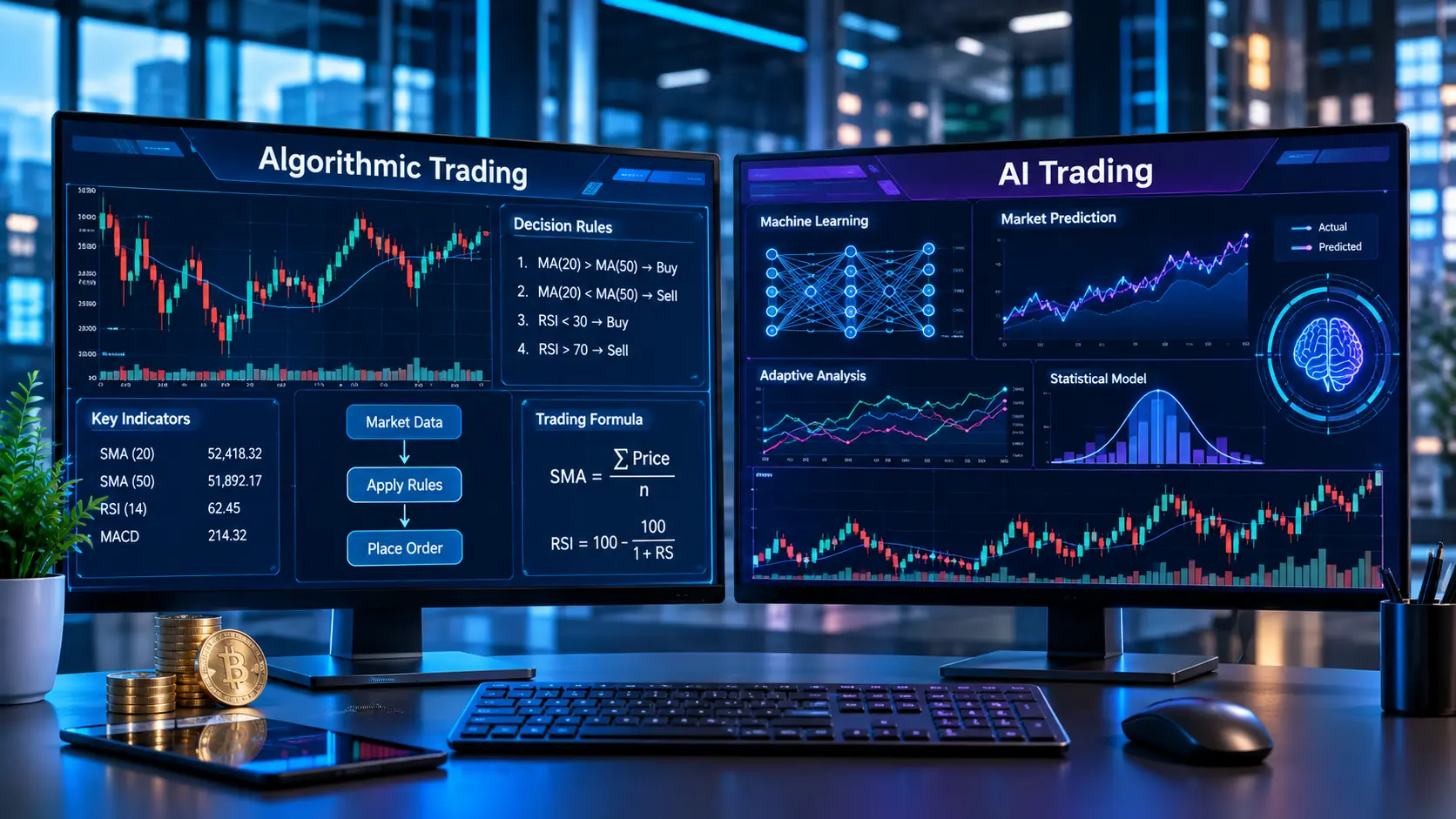
AI trading vs algorithms is an important comparison for investors exploring automated financial strategies. Both approaches use computer systems to analyze markets and support trading decisions, but they differ in how they develop strategies, interpret information, and respond to changing conditions.
Traditional algorithmic trading generally follows predefined mathematical rules. AI trading uses machine learning and statistical models that can identify relationships within financial data.
However, neither approach guarantees profitable outcomes. Understanding their differences helps investors evaluate trading technology without confusing sophisticated automation with reliable investment performance.
What Is Traditional Algorithmic Trading?
Traditional algorithmic trading uses computer programs to execute trading instructions based on predetermined conditions.
These conditions may involve asset prices, trading volume, technical indicators, or specific market events.
For example, a rule-based trading strategy might purchase an asset when its 20-day moving average crosses above its 50-day moving average.
The system follows the programmed condition whenever the required market information becomes available.
Common traditional algorithmic strategies include:
- Moving average crossover strategies.
- Statistical arbitrage.
- Trend-following systems.
- Mean-reversion strategies.
- Market-making algorithms.
- Time-weighted and volume-weighted execution strategies.
These approaches can be mathematically sophisticated, even when they do not use machine learning.
Their defining characteristic is that the trading logic follows explicitly designed rules or statistical procedures.
What Is AI Trading?
AI trading applies artificial intelligence techniques to financial market analysis, forecasting, or trading decisions.
Machine learning models can examine historical information and identify statistical relationships that developers may not define manually.
For example, an AI model might analyze price momentum, trading volume, volatility, and broader market indicators to estimate the probability of a particular price movement.
Some systems also use neural networks, ensemble learning, or other predictive modeling techniques.
However, AI trading is not necessarily fully autonomous.
A platform may provide AI-generated signals while requiring users to approve transactions. Another system may connect predictive models directly to automated execution software.
Therefore, investors should distinguish AI-based analysis from actual trading automation.
AI Trading vs Traditional Algorithmic Trading: Main Differences
The most important differences involve strategy development, model behavior, and interpretation.
| Feature | Traditional Algorithmic Trading | AI Trading |
|---|---|---|
| Decision process | Predefined trading rules | Learned statistical relationships |
| Strategy development | Explicit programming and quantitative research | Model training and feature selection |
| Adaptability | Requires rule changes or programmed adjustments | May adapt through retraining or model updates |
| Data processing | Uses selected indicators and market variables | Can analyze complex combinations of inputs |
| Interpretability | Often easier to explain | Can be difficult to interpret |
| Main technical risks | Incorrect rules and market assumptions | Overfitting, model drift, and data problems |
| Backtesting | Essential | Equally essential |
These categories overlap in practice.
For example, traditional quantitative trading systems can incorporate adaptive statistical techniques, while AI platforms may still rely on fixed execution rules.
The distinction is therefore about the analytical approach rather than whether software places orders automatically.
AI Trading vs Algorithms: Strategy Development
Traditional trading strategies often begin with a hypothesis.
A quantitative researcher might believe that an asset tends to recover after unusually large short-term declines.
The researcher then develops mathematical rules to test that assumption.
Machine learning can approach the problem differently.
Instead of specifying every relationship manually, developers train a model using historical observations and selected features.
The model attempts to identify patterns associated with particular outcomes.
Supervised Learning
Supervised learning uses historical examples with known outcomes.
For example, a model may learn relationships between market indicators and subsequent price movements.
However, historical associations may weaken or disappear when market conditions change.
Reinforcement Learning
Reinforcement learning involves training a system to select actions based on feedback from an environment.
In financial applications, researchers may explore reinforcement learning for sequential trading decisions.
Nevertheless, realistic training environments are difficult to construct because live markets involve transaction costs, changing liquidity, and unpredictable behavior.
AI Trading vs Algorithms: Market Adaptability
AI models can potentially respond to changing market conditions when their architecture supports updated inputs, retraining, or adaptive decision-making.
However, adaptation is not automatic.
A model trained on historical data may continue using outdated relationships unless developers actively update or redesign it.
Traditional algorithmic systems can also adapt through volatility filters, dynamic parameters, and programmed market-regime detection.
Therefore, investors should evaluate how a system handles changing conditions rather than assuming that AI technology is inherently more adaptable.
Multi-Model Approaches
Some AI trading systems combine several analytical models to evaluate market information from different perspectives.
For example, one model may focus on momentum while another examines volatility or statistical relationships.
A combined system can compare their outputs before generating an assessment.
Investors exploring an AI trading platform can examine Hyperlyx AI, which describes a multi-model trading intelligence architecture.
Its stated approach illustrates how multiple analytical models may contribute to market assessments. However, users should verify the platform’s actual capabilities, model evaluation methods, and available performance evidence before making financial decisions.
Combining models does not guarantee more accurate predictions, particularly when their underlying assumptions are similar.
Backtesting AI Trading vs Algorithms
Backtesting evaluates how a trading strategy would have performed using historical market information.
Both traditional algorithms and AI models require careful testing.
However, backtesting results can become misleading when researchers repeatedly adjust strategies to fit historical data.
This problem is known as overfitting.
An overfitted strategy may perform impressively on past observations while failing when exposed to new market conditions.
AI systems face an additional concern called data leakage, which occurs when information unavailable at the time of a prediction improperly enters model development or testing.
To evaluate either approach, investors should consider:
- Out-of-sample performance.
- Walk-forward testing.
- Transaction fees and slippage.
- Maximum historical drawdown.
- Performance across different market conditions.
- Live results where independently verifiable.
Strong historical performance alone cannot establish future profitability.
Which Trading Approach Is More Suitable for Investors?
Choosing between AI trading vs algorithms depends on investment goals, technical requirements, and the level of automation an investor needs.
The appropriate approach depends on the investor’s objectives, technical understanding, and risk tolerance.
Traditional algorithmic strategies may appeal to investors who value clearly defined rules and easier explanations of individual decisions.
AI-based approaches may interest investors seeking more complex market analysis or predictive modeling.
However, greater complexity can make a system harder to evaluate.
Investors should also consider whether they need analytical assistance, automated execution, or both.
For example, a long-term investor may benefit more from market monitoring than frequent automated transactions.
Meanwhile, an experienced quantitative trader may prefer a transparent rule-based strategy that can be tested and modified directly.
Neither approach is universally superior.
Conclusion
The comparison between AI trading and traditional algorithmic trading highlights two different ways of applying computational methods to financial markets.
Traditional algorithms generally execute explicitly defined strategies, while AI trading systems use machine learning to identify patterns and generate predictions.
Both approaches can support sophisticated market analysis, and both remain vulnerable to inaccurate assumptions, changing market conditions, and execution risks.
Ultimately, investors should prioritize transparent strategy design, realistic testing, understandable risk controls, and verifiable performance evidence rather than choosing technology based solely on whether it carries an artificial intelligence label.