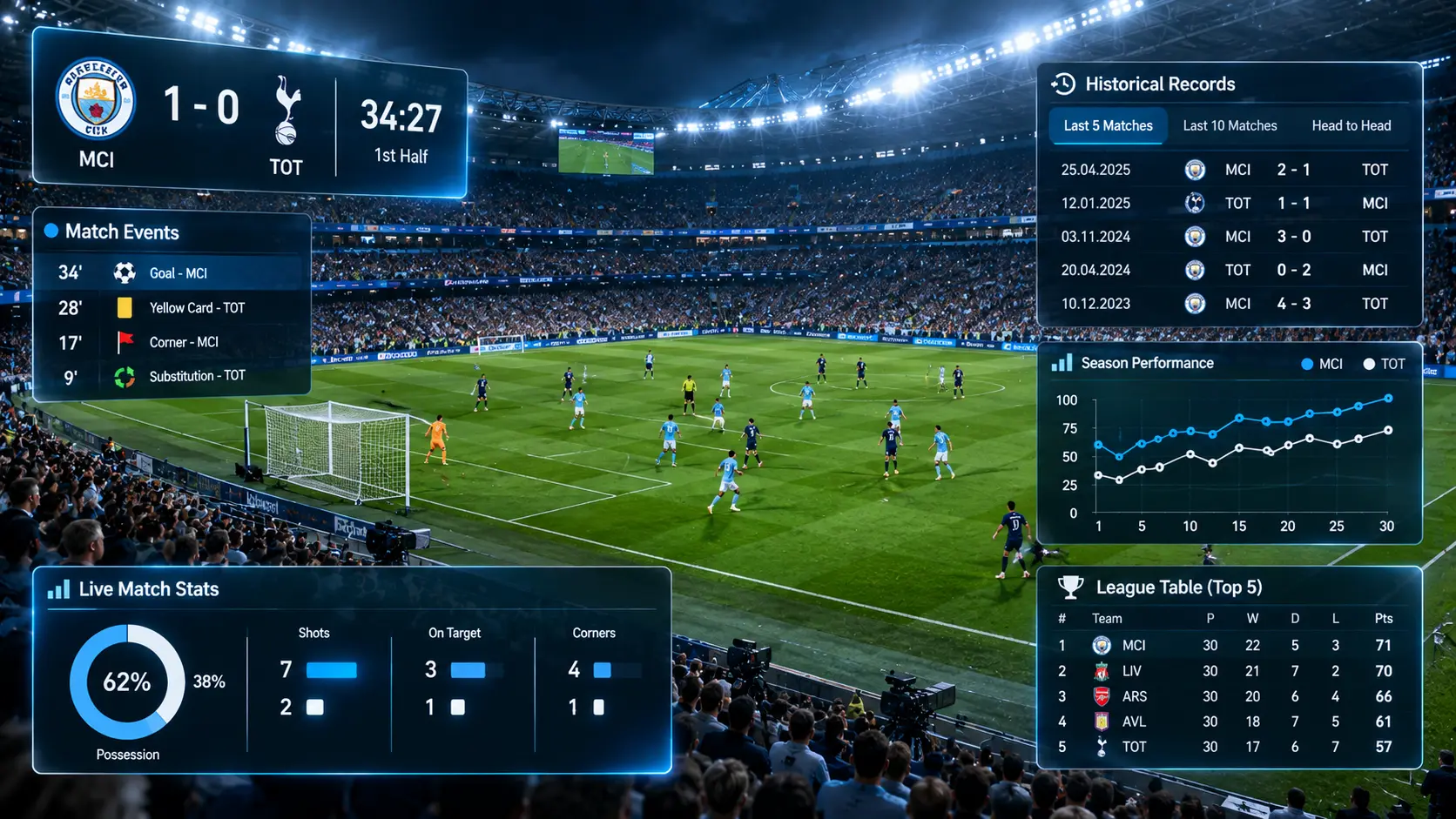
Live football data describes match events and performance information collected while a game is taking place. Historical statistics, in contrast, contain records from completed matches, previous seasons and past competitions.
The main difference between these information types is timing. Live data explains what is happening during a match, whereas historical statistics provide context about what has happened previously.
Both play important roles in sports journalism, performance research, tactical analysis and digital football coverage.
What Is Live Football Data?
Live football data consists of continuously updated information that reflects developments during an ongoing match.
Sports data providers collect and distribute this information through digital systems, event feeds and specialized monitoring technologies.
Typical live match information includes:
- Current scores and match time.
- Goals, assists and substitutions.
- Yellow and red cards.
- Shots and shots on target.
- Ball possession and passing statistics.
- Fouls, corners and other match events.
- Changes in team formations and player positions.
These updates allow audiences to follow important developments without necessarily watching the entire match.
However, the availability and accuracy of individual statistics depend on the data collection methods used by each provider.
What Are Historical Football Statistics?
Historical football statistics are structured records of completed sporting events. They allow researchers, journalists and analysts to examine performance patterns across different periods.
Historical datasets may include previous match results, seasonal league standings, player appearances, scoring records and competition histories.
For example, a club’s defensive performance across an entire season provides a broader perspective than its defensive statistics during the opening minutes of a single match.
Historical information also supports research into tactical development, player careers and changes in competitive football.
Comparing Live Football Data and Historical Statistics
Although both information types describe football performance, they serve different analytical purposes.
| Comparison factor | Live football data | Historical statistics |
|---|---|---|
| Time frame | Ongoing matches | Completed matches and seasons |
| Update frequency | Continuously or periodically | After events and subsequent revisions |
| Main purpose | Monitoring current developments | Examining established performance patterns |
| Information status | May be provisional | Generally more settled |
| Common applications | Live reporting and match coverage | Research and retrospective analysis |
| Main limitation | Delays and temporary inaccuracies | Reduced relevance when circumstances change |
Live information provides immediacy, while historical records offer broader statistical context.
How Digital Football Publications Use Different Data Types
Football websites present information in various formats depending on their editorial focus and audience requirements.
Live-score services prioritize match updates, while analytical publications may concentrate on historical performance, tactical developments and statistical explanations.
Other resources, including BET404’s football-related content, discuss football predictions and commercial platform-related subjects for Persian-speaking audiences. Such material should be distinguished from independently collected live event feeds and verified historical records.
Professional sports data organizations such as Stats Perform contribute to the wider football information ecosystem by collecting, organizing and distributing structured sports data.
The distinction between original data collection and secondary interpretation remains important when evaluating online football information.
Why Live Football Updates Sometimes Appear Delayed
Data latency refers to the time between an event occurring and its information reaching a digital platform or end user.
For instance, a goal may appear on one football application before another because the services use different data feeds, processing systems or verification procedures.
Several factors can contribute to these delays, including network connectivity, event confirmation, technical infrastructure and manual review processes.
Video assistant referee decisions can also result in temporary discrepancies. A platform may initially display a goal before updating the score following an official decision.
Therefore, live football data should sometimes be regarded as provisional until the relevant event receives confirmation.
How Historical Records Provide Context for Live Events
A live statistic can describe an immediate situation without explaining its wider significance.
Imagine a football team records eight shots during the first half of a match. This information indicates attacking activity, but it does not automatically establish whether the performance is unusual.
Historical records can provide additional context by showing the team’s typical shooting frequency, attacking tendencies and previous performances under comparable conditions.
However, comparisons should account for differences in opposition, match situations and tactical approaches.
Combining current observations with relevant historical information creates a more complete picture of sporting performance.
Can Historical Football Statistics Change?
Yes. Although historical statistics describe completed events, data providers may revise their records after identifying errors or reviewing individual incidents.
For example, a statistical provider might correct a player’s recorded assist or reclassify a particular shot following a detailed video review.
Different providers may also apply different definitions when recording tackles, interceptions or scoring opportunities.
Consequently, historical datasets are generally more stable than live feeds, but they are not necessarily identical across every information source.
Understanding the Limitations of Football Data
Neither live nor historical information captures every factor influencing a football match.
Live statistics may lack sufficient context, while historical records cannot fully represent changing team conditions or unexpected developments.
Furthermore, statistical information does not guarantee future match outcomes. Even comprehensive datasets cannot eliminate sporting uncertainty or the financial risks associated with gambling.
Readers should distinguish factual match information from subjective interpretations and probability-based forecasts.
Conclusion
Live football data and historical statistics fulfill distinct but complementary roles in modern sports information. Live updates communicate ongoing match developments, while historical records help explain broader performance patterns and previous events. Understanding data latency, statistical revisions and differences between information sources allows football enthusiasts to interpret both categories more effectively. Together, these resources provide a richer understanding of football when their individual limitations are properly recognized.