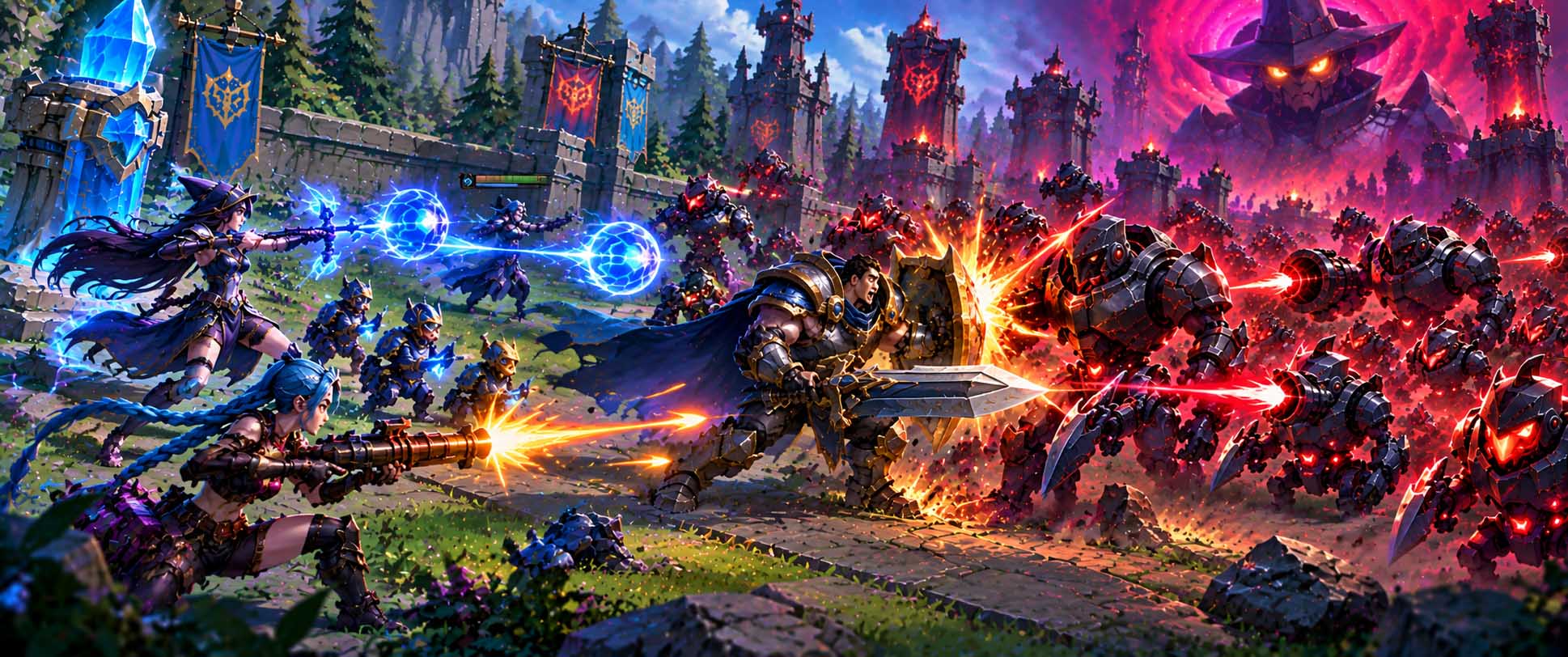
Choosing between ranged vs melee champions in Doom Bots is less about which category is universally stronger and more about how each handles PvE pressure. Ranged champions can often deal damage from safer positions and provide reliable wave clear, while melee champions may offer durability, frontline presence, sustain, and close-range pressure.
The best choice depends on the champion’s specific kit and the needs of the team. Doom Bots rewards complementary strengths, so understanding how range changes positioning, survivability, and damage delivery can help players build a more functional lineup.
How PvE Changes the Ranged vs Melee Comparison
In standard League of Legends matches, champion range is evaluated partly around laning, trades, matchups, and interactions with human opponents.
Doom Bots creates a different environment.
Players face AI-controlled threats and repeated PvE pressure, which can make characteristics such as AoE damage, safe positioning, survivability, and sustained contribution especially useful.
This changes how ranged and melee champions should be evaluated.
A ranged champion may benefit from attacking without ranged vs melee champions in Doom Bots immediately entering close combat. A melee champion may compensate for shorter range with durability, sustain, mobility, or the ability to create space for teammates.
Neither category tells the full story by itself.
Why Ranged Champions Can Feel Safer in Doom Bots
Range provides one immediate advantage: distance.
A ranged champion can often begin attacking before an enemy reaches close-combat distance. This creates additional time to deal damage, observe incoming threats, and reposition.
That extra space can be useful when several enemies are approaching simultaneously.
Ranged champions may also find it easier to attack while remaining behind a durable teammate. When a frontline champion occupies dangerous areas, a mage or marksman can contribute from a more protected position.
However, distance does not guarantee safety.
Many ranged champions are vulnerable when enemies successfully reach them. Poor positioning can quickly remove the advantage that range provides.
Ranged Wave Clear Can Control Enemy Pressure
Many ranged mages and other AoE-focused champions can damage groups before those enemies reach the team’s position.
This makes ranged wave clear particularly useful for controlling space.
Champions such as Ziggs, Brand, or other area-damage picks illustrate the general advantage. Their abilities can pressure multiple targets without requiring the player to stand directly inside the enemy group.
Efficient ranged clearing can also help the team maintain better formation.
Instead of everyone moving forward to engage a wave, some teammates can stay in safer positions while applying damage.
Still, a ranged champion should ideally offer something beyond wave clear. Sustained damage, crowd control, utility, or useful boss pressure can make the pick more versatile as the encounter changes.
What Melee Champions Bring to Doom Bots
Melee champions approach PvE pressure from a different position.
Because they generally need to fight closer to enemies, successful melee picks often depend on characteristics that help them survive that proximity.
Useful qualities can include:
- Durability
- Healing or sustain
- Defensive abilities
- Mobility
- Crowd control
- Consistent close-range damage
- Frontline presence
A durable melee champion can occupy space that would be dangerous for a fragile ranged character.
This can benefit the entire team.
If enemies are concentrating pressure near a durable fighter, ranged allies may have more freedom to attack from behind.
Frontline Presence Is a Major Melee Advantage
One of the clearest contributions of certain melee champions is their ability to function as a frontline.
A frontline creates separation between incoming threats and vulnerable teammates.
This role is not simply about absorbing damage. Good frontline play helps control where combat happens.
A durable fighter can pressure enemies at close range while ranged champions maintain distance. Crowd-control champions can then use their abilities more effectively because the team’s formation remains organized.
Melee champions such as Darius, Mordekaiser, Volibear, or Illaoi represent different examples of fighters whose durability or sustained close-range presence can be useful qualities in PvE.
The specific effectiveness of any pick still depends on its full kit and how it fits the composition.
Melee Champions Need a Way to Handle Close-Range Risk
Short attack range creates an obvious challenge: melee champions usually have less distance separating them from danger.
For this reason, a melee pick needs a practical answer to incoming pressure.
That answer may be durability. It may be healing, shielding, mobility, crowd control, or another defensive mechanic.
A melee champion that deals strong damage but cannot remain active at close range may struggle to deliver that damage consistently.
This is why theoretical output should not be evaluated separately from survivability.
The best close-range picks can continue performing their job without forcing the team to spend excessive resources keeping them alive.
Mobility Can Reduce the Difference Between Ranged and Melee Picks
Mobility changes how a champion interacts with range.
A mobile melee champion may be able to enter and leave dangerous areas quickly, reducing some of the disadvantages of short range. Similarly, a mobile ranged champion can reposition when enemies close the distance.
This makes effective range more complicated than simply looking at attack distance.
A champion’s movement abilities, cooldowns, crowd control, and defensive tools all influence how safely it can operate.
Players should therefore ask whether the champion can reliably reach the position it needs and leave that position when conditions become dangerous.
That question often reveals more than the ranged or melee label alone.
Compare Champion Roles, Not Just Attack Range
A useful comparison should consider what the champion contributes to the whole team.
For example, a ranged mage may provide AoE damage and crowd control. A melee bruiser might offer frontline durability and sustained damage. A marksman may specialize in consistent ranged DPS, while another fighter could combine sustain with close-range pressure.
These are different functions rather than direct replacements for one another.
When players compare possible Doom Bots picks, range should therefore be considered alongside wave clear, survivability, mobility, crowd control, sustained damage, and team utility.
The strongest selection is usually the one that fills a weakness in the existing composition.
Can an All-Ranged Team Work?
An all-ranged lineup can offer excellent distance and potentially strong wave control, but it may create problems if enemies successfully reach the team.
Without enough frontline strength, crowd control, or defensive utility, several fragile champions can be pressured simultaneously.
An all-ranged composition therefore needs other ways to maintain space.
Strong slows, roots, zoning, mobility, shields, or other defensive tools may compensate for the lack of a conventional melee frontline.
The important issue is not whether every champion attacks from range. It is whether the team can preserve that range when pressure increases.
If it cannot, the composition’s main advantage becomes difficult to use.
Can a Melee-Heavy Team Work?
A melee-heavy lineup creates the opposite challenge.
Durable fighters may provide strong frontline pressure and survivability, but the composition can become crowded around dangerous targets. It may also have fewer options for dealing damage from safer positions.
This makes ranged support valuable even when several melee champions are effective individually.
A mage, marksman, or other ranged pick can diversify the team’s damage pattern and allow pressure to continue when moving into close range would be unsafe.
Melee-heavy teams also benefit from good crowd control and mobility so that champions can choose when to engage rather than constantly chasing threats.
Balance Range With Durability and Utility
The most practical team is often one where ranged and melee strengths complement each other.
A durable melee champion can create space. A ranged damage dealer can use that space to attack safely. An AoE mage can control groups, while utility or crowd control helps both sides maintain favorable positioning.
The exact number of ranged or melee champions is less important than the functions they collectively provide.
A balanced composition should ask:
Can someone safely occupy the frontline?
Can the team clear groups efficiently?
Is there reliable sustained damage?
Can vulnerable champions maintain safe positions?
Does the team have enough crowd control or utility to manage pressure?
If those needs are covered, several different ranged-melee combinations can work.
Choose for Function, Not Category
The ranged vs melee champions in Doom Bots comparison does not produce one universal winner. PvE changes the value of champion characteristics by emphasizing how reliably each pick can perform under repeated pressure.
Ranged champions can provide safer damage, AoE wave clear, and positional flexibility, but they may need protection when enemies close the gap. Melee champions can contribute frontline strength, durability, sustain, and close-range pressure, but they need reliable ways to survive dangerous positions.
The better approach is to evaluate what the team already has and what it still needs. Range is one important characteristic, but survivability, mobility, damage, wave clear, crowd control, and utility ultimately determine how well a champion fits the Doom Bots composition.